
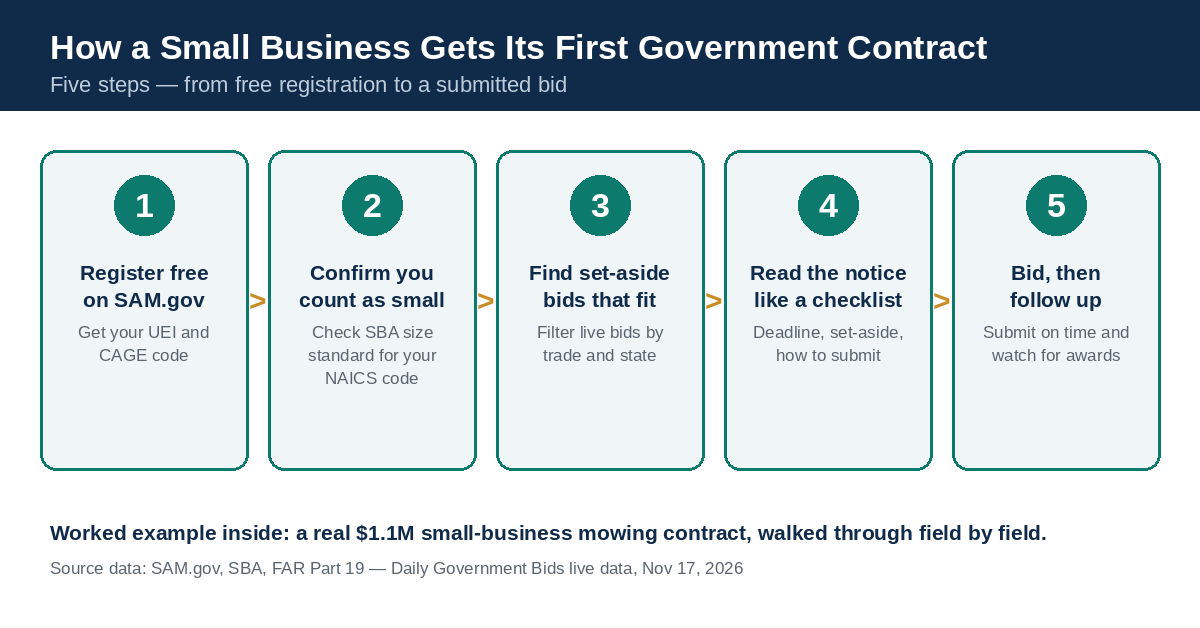
A small business gets government contracts in five steps: register free on SAM.gov and get a UEI, confirm you meet the SBA size standard for your NAICS code, find contracts set aside for small businesses, read each notice carefully, and submit a complete bid before the deadline.
That short answer hides a lot of detail, so this guide walks through every step in plain English. Even better, it ends with a real contract that is open right now, read field by field, so you can see exactly what a bid looks like before you ever submit one.
Why small businesses win so much government work
First, it helps to know the game is not rigged against you. By law, the federal government aims to award at least 23% of its prime contract dollars to small businesses every year. In fact, the SBA scorecard for fiscal year 2025 reported that nearly 28% of prime contract dollars went to small businesses, so agencies beat the goal.
Agencies reach that goal mainly through set-asides. A set-aside is a contract that only small businesses may compete for, so you never bid against a giant corporation. Under the Federal Acquisition Regulation (FAR 19.502-2), contracting officers set work aside whenever they reasonably expect at least two small businesses to offer a fair price. That test is called the “Rule of Two,” and it creates thousands of small-business-only competitions every year.
Step 1: Register on SAM.gov — it is free, but start early
Every federal contract starts at SAM.gov, the System for Award Management run by the General Services Administration (GSA). Registration is always free. Anyone who charges you to register is selling you something the government gives away.
When you register, SAM.gov validates your legal business name and address and assigns two identifiers:
- UEI (Unique Entity ID) — your business’s ID number in federal systems. It replaced the old DUNS number in April 2022.
- CAGE code — a five-character code used mainly for defense and payment processing.
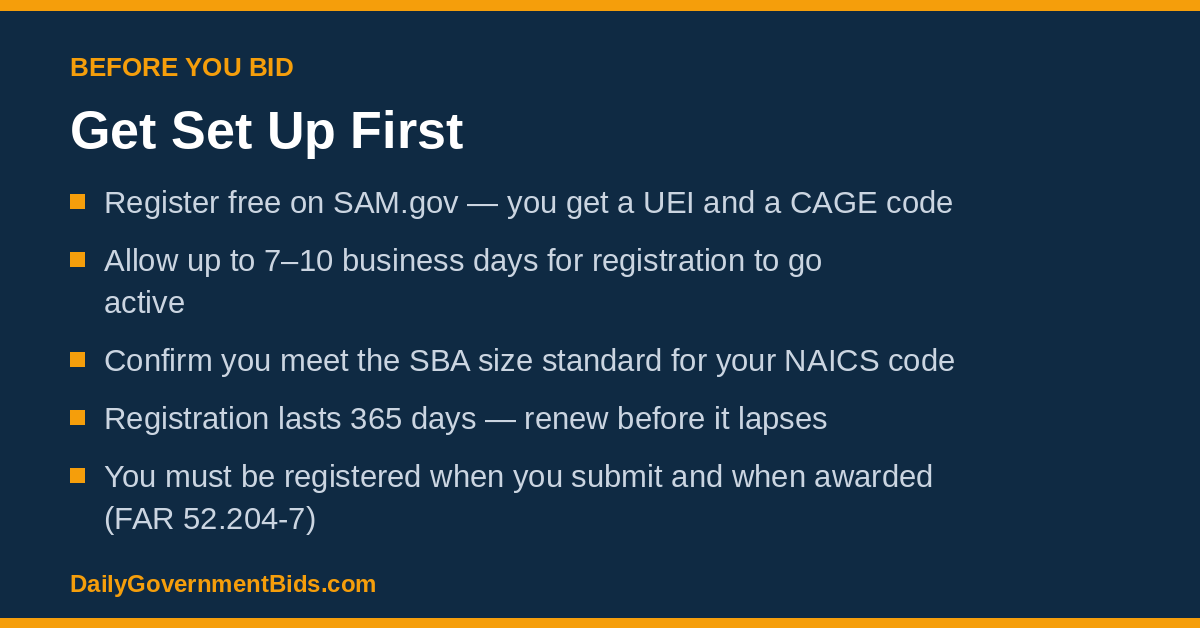
However, free does not mean instant. After you submit, the IRS checks your tax ID and the CAGE program validates your details. The Federal Service Desk advises you to allow up to 7–10 business days for a registration to become active, and document reviews can add more time. Under FAR 52.204-7, you must be registered when you submit an offer and when the contract is awarded, so a late registration can disqualify an otherwise winning bid.
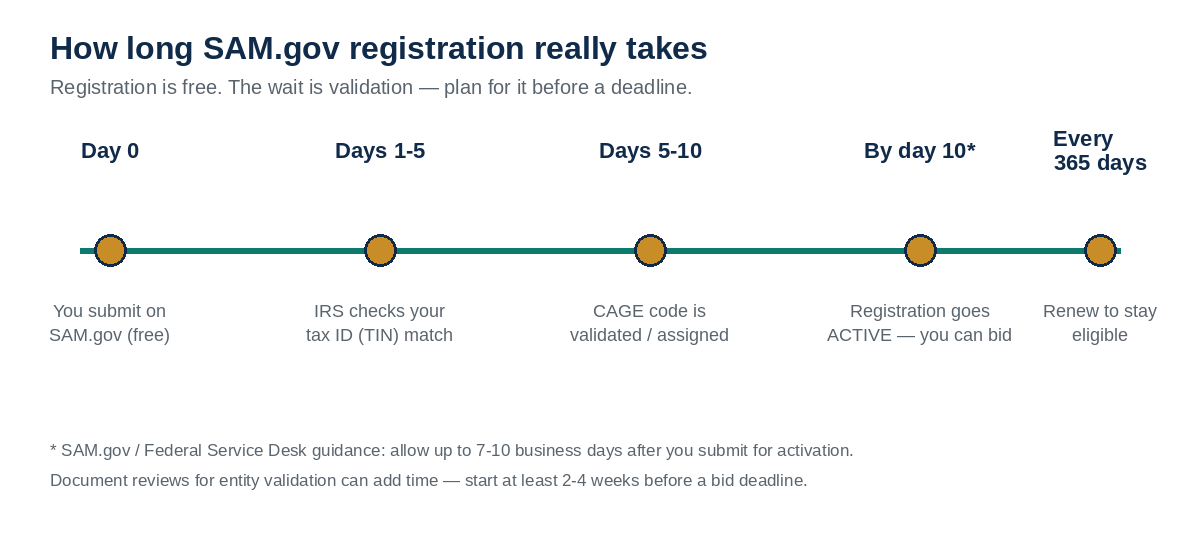
Finally, mark your calendar: a SAM.gov registration lasts 365 days. If it lapses, you cannot receive an award until it is active again.
Step 2: Confirm your business counts as “small”
“Small” is not a feeling — it is a number. The U.S. Small Business Administration (SBA) sets a size standard for every NAICS code, based on either annual revenue or number of employees. NAICS codes are the industry codes that describe what your business does, such as 561720 for janitorial services or 561730 for landscaping services.
So, before you bid, do three quick checks:
- Pick the NAICS codes that match the work you actually sell.
- Look up the size standard for each code in the SBA table.
- Confirm your revenue or headcount sits under that line, and list those NAICS codes in your SAM.gov registration.
If you sit under the standard, you are “small” for that work, and every set-aside in that category is open to you.
Step 3: Find set-aside contracts that fit your business
Next, you need a steady list of open bids. SAM.gov posts federal opportunities, but most small businesses do better with a filtered daily list that groups bids by trade and state. On this site, the live government bids page shows currently open opportunities, refreshed twice a day, and each listing links back to its official source.
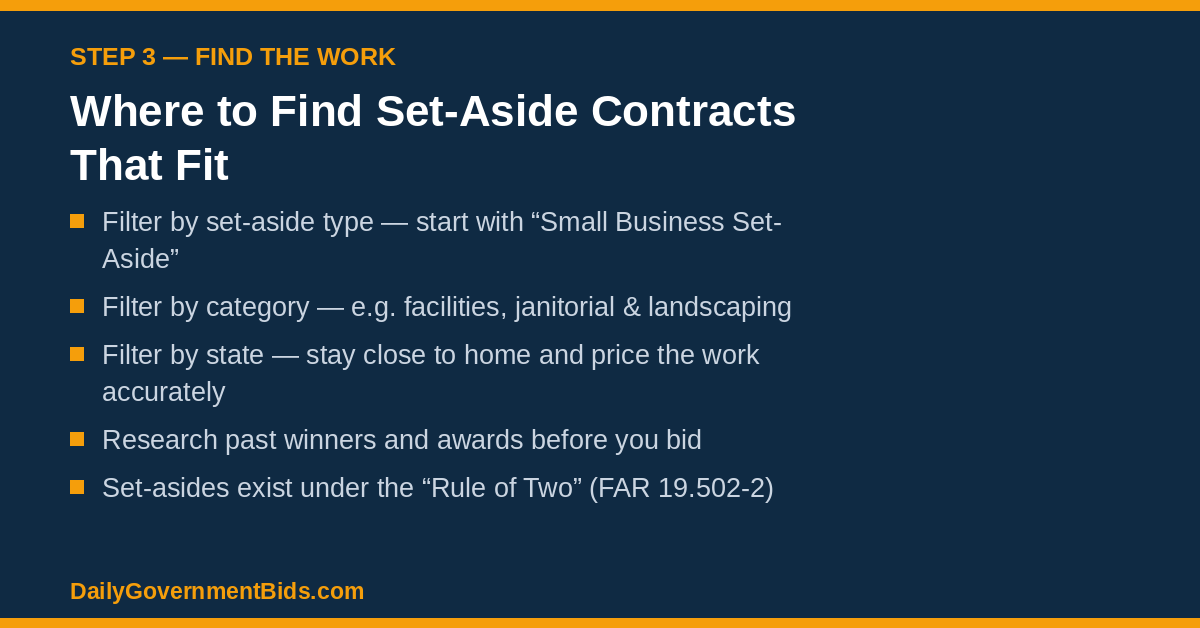
Then narrow the list with three filters:
- Set-aside type — start with “Small Business Set-Aside” so you only see work reserved for firms like yours.
- Category — for example, facilities, janitorial and landscaping bids if you clean or maintain buildings and grounds.
- State — use the government bids by state hub to stay close to home, where you can visit the site and price the work accurately.
Also, research before you bid. The government contract companies directory shows which firms already win work in your field, and the government contract awards pages show what agencies actually paid. USAspending.gov, the official federal spending database, tells the same story at national scale.
Worked example: a real open bid, read field by field
Theory only goes so far, so here is a real contract from this site’s live data on November 17, 2026. It is open now, and it is reserved for small businesses.
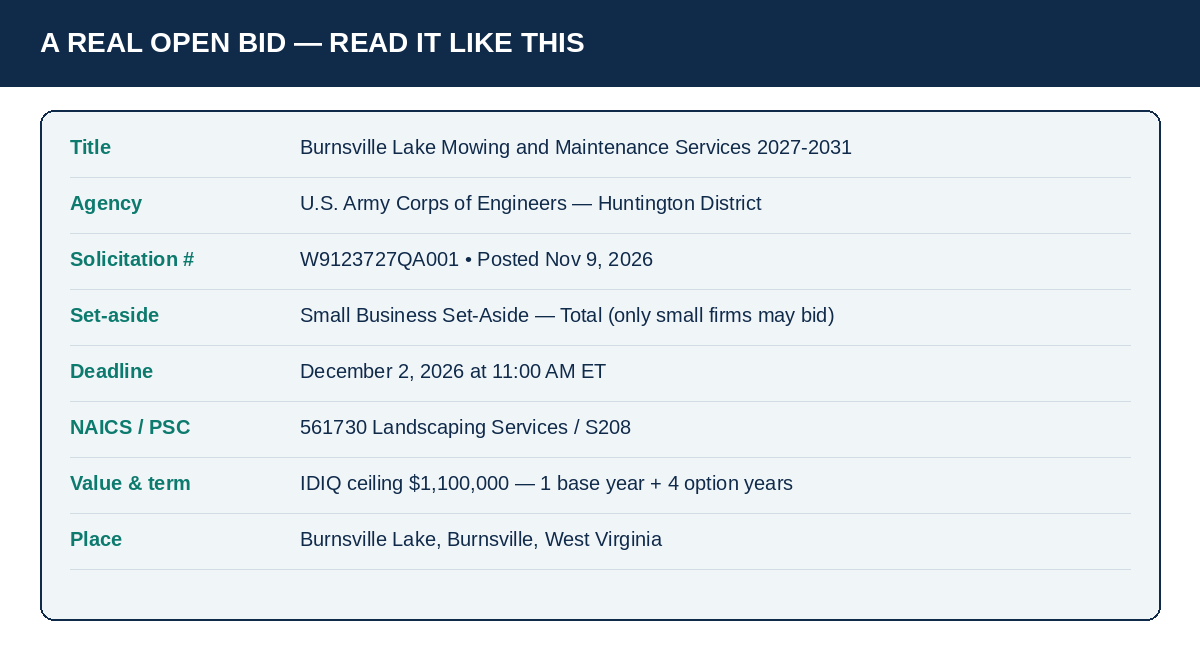
Here is how a beginner should read it:
- Title and agency. “Burnsville Lake Mowing and Maintenance Services 2027–2031” comes from the U.S. Army Corps of Engineers, Huntington District. The buyer is real, named, and reachable through the official SAM.gov posting.
- Set-aside. “Small Business Set-Aside — Total” means only small businesses may bid. No large company can take this one.
- Deadline. Quotes close December 2, 2026 at 11:00 AM ET. Late means out, with no exceptions, so this date drives your whole schedule.
- NAICS 561730. That is Landscaping Services. If your SAM.gov profile lists this code and you are under its SBA size standard, you qualify on size.
- Value and term. It is an IDIQ contract (indefinite delivery, indefinite quantity) with a ceiling of $1,100,000 over one base year plus four option years. In plain terms, the winner could earn work across five years from one win.
- Evaluation. The notice says award considers past performance, management, and equipment as well as price — so the cheapest quote does not automatically win.
You can open the official posting yourself from the live bids list and search its solicitation number, W9123727QA001, on SAM.gov. That habit — verify every listing at its official source — protects you from stale copies and scams.
Step 4: Decide whether you need a special certification
Some set-asides are reserved for smaller groups inside the small-business pool. You do not need any of these certifications to bid on a general small business set-aside. Still, each one opens extra doors if you qualify:
| Program | Who it is for | What it adds |
|---|---|---|
| 8(a) Business Development | Small businesses owned by socially and economically disadvantaged individuals | Set-aside and sole-source contracts, plus SBA mentoring, for up to nine years |
| HUBZone | Small businesses located in historically underused business zones, with staff living there | HUBZone set-asides and a price preference in open competitions |
| Women-Owned Small Business (WOSB) | Businesses at least 51% owned and controlled by women | WOSB and EDWOSB set-asides in industries where women are underrepresented |
| Service-Disabled Veteran-Owned (SDVOSB) | Businesses owned by service-disabled veterans | SDVOSB set-asides, used heavily by the Department of Veterans Affairs |
Certification runs through the SBA and is free. Apply only when buyers in your industry actually use the program, because the paperwork takes real time.
Step 5: Submit a complete bid — then build your record
Finally, the bid itself. Every notice explains exactly how to submit, and the rules differ: some take email, while others require an official portal such as PIEE. Follow the notice word for word. Most losing bids fail on simple points — a missing form, a wrong file, or a deadline missed by minutes.
Use this pre-bid checklist for every opportunity:
| Check | Why it matters |
|---|---|
| SAM.gov registration active | Required at offer and at award under FAR 52.204-7 |
| Set-aside matches your status | A bid in the wrong pool is rejected, however good the price |
| NAICS code listed in your profile | Buyers check size against the notice’s NAICS code |
| Every form signed and attached | Incomplete submissions are not considered |
| Deadline converted to your time zone | Notices mix ET, CT, and local times — confirm which one applies |
| Submission method confirmed | Email, portal, or mail — the notice decides, not you |
After you submit, keep going. Each bid teaches you the buyer’s format, and each win becomes past performance — the very thing evaluators score next time. For the full walkthrough of the bidding process itself, read our guide on how to bid on a government contract, then return to the live list and pick your next target.
Frequently asked questions
Is SAM.gov registration free?
Yes. Registration on SAM.gov is always free, and so is renewal. The government never charges for it. Private companies may offer paid help, but the registration itself costs nothing.
How long does SAM.gov registration take?
Plan on up to 7–10 business days after you submit, per Federal Service Desk guidance. The IRS tax ID check and CAGE validation happen in that window. If SAM.gov needs documents to validate your business, it can take longer, so start at least two to four weeks before any deadline.
What is a set-aside contract?
A set-aside is a contract reserved for a defined group — most often small businesses — so only firms in that group may compete. Contracting officers create set-asides under FAR Part 19 when at least two qualified small businesses are expected to bid at fair prices.
Do I need 8(a), HUBZone, WOSB, or SDVOSB certification to bid?
No. A general small business set-aside only requires that you meet the SBA size standard for the contract’s NAICS code and hold an active SAM.gov registration. The certifications only matter for set-asides reserved for those specific programs.
Where can a small business find government contracts?
Federal opportunities post on SAM.gov, and state and local work posts on state procurement portals. A filtered daily list, such as this site’s live bids page, saves time because it groups open bids by category and state and links each one to its official source.
How much does it cost to bid on a government contract?
Usually, bidding costs your time rather than fees: registration is free, and most notices accept free electronic submissions. Your real costs are the hours spent reading the notice, pricing the work, and preparing a complete, on-time response.
Sources: SAM.gov and the Federal Service Desk (registration timing, UEI, CAGE); U.S. Small Business Administration (size standards, certification programs, FY2025 scorecard); Federal Acquisition Regulation Part 19 and FAR 52.204-7 via acquisition.gov; USAspending.gov. Worked example: SAM.gov solicitation W9123727QA001, U.S. Army Corps of Engineers, posted November 9, 2026, as listed in Daily Government Bids live data on November 17, 2026. Deadlines and availability change — always confirm a listing at its official source before bidding.