
By Michael Grant
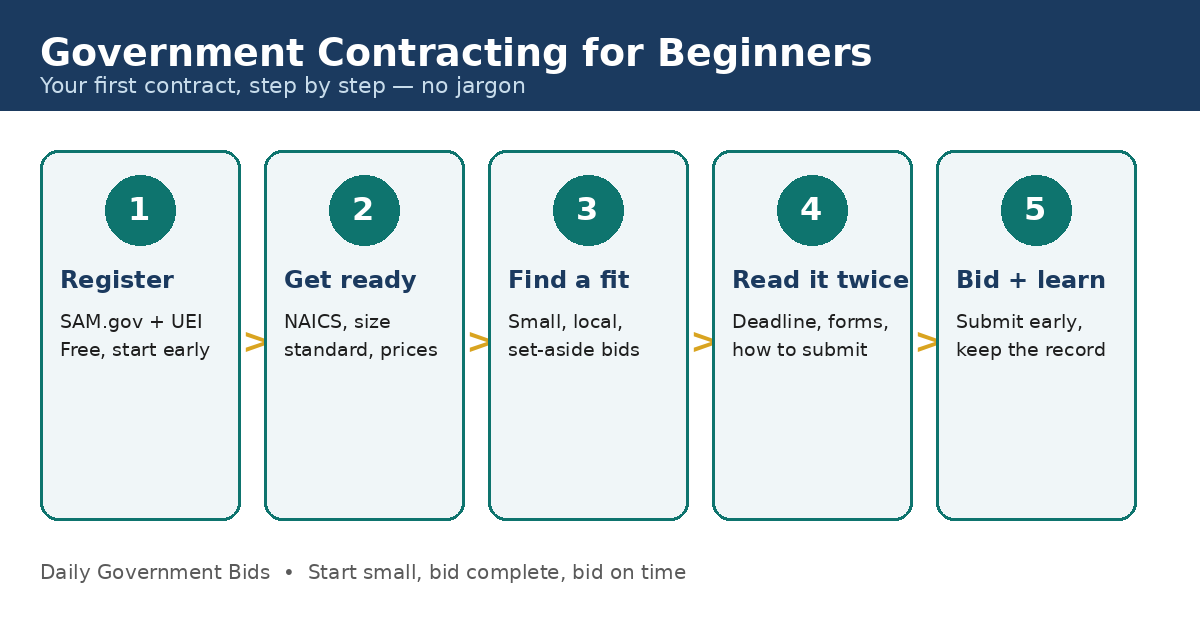
Government contracting for beginners comes down to four moves: register your business free on SAM.gov and get a UEI, confirm you count as small for the work you sell, start with one small set-aside bid close to home, and submit a complete bid, early, exactly the way the notice asks.
That is the whole game in one paragraph. The rest of this article slows it down, week by week, the way someone would explain it across a workbench. No jargon without a plain-English translation. No hype, either — your first contract will probably be small, and that is a good thing.
What is a government contractor, in plain English?
A government contractor is just a business the government pays to do work or supply goods — cleaning an office, mowing a lake park, fixing a roof, delivering parts. You do not work for the government. You sell to it, under a written contract, at a price you proposed.
Three things surprise most beginners. First, the buyer is not one giant office. Thousands of separate offices buy, from a Forest Service district in South Carolina to a veterans’ cemetery in Colorado, and each posts its own notices. Second, small businesses are not an afterthought. Federal law sets a goal of at least 23% of prime contract dollars going to small businesses, and the SBA scorecard for fiscal year 2025 put the real figure near 28%. Third, the system runs on paperwork and deadlines, not handshakes. If you can read carefully and hit a date, you already have the main skill.
Your first 30 days: a calm plan that actually fits a real business
Most beginners stall because they try to learn everything at once. Don’t. Here is a pace that works alongside a running business.
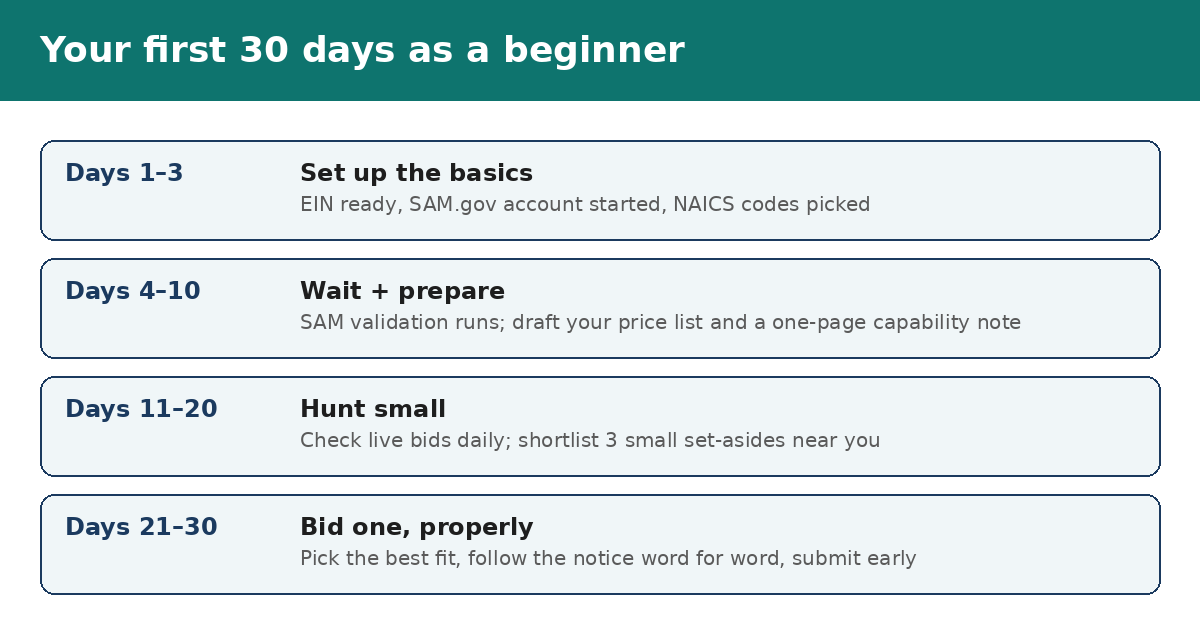
Days 1–3 — set up. Start your free registration on SAM.gov. You will need your legal business name exactly as the IRS has it, your address, and your tax ID. SAM.gov assigns your UEI (Unique Entity ID) — your business’s ID number in federal systems — and a CAGE code used for payments and defense work. Pick the NAICS codes that match what you actually sell. NAICS is just the government’s list of industry labels: 561720 is janitorial services, 561730 is landscaping, 238220 is plumbing and HVAC. Two or three honest codes beat ten hopeful ones.
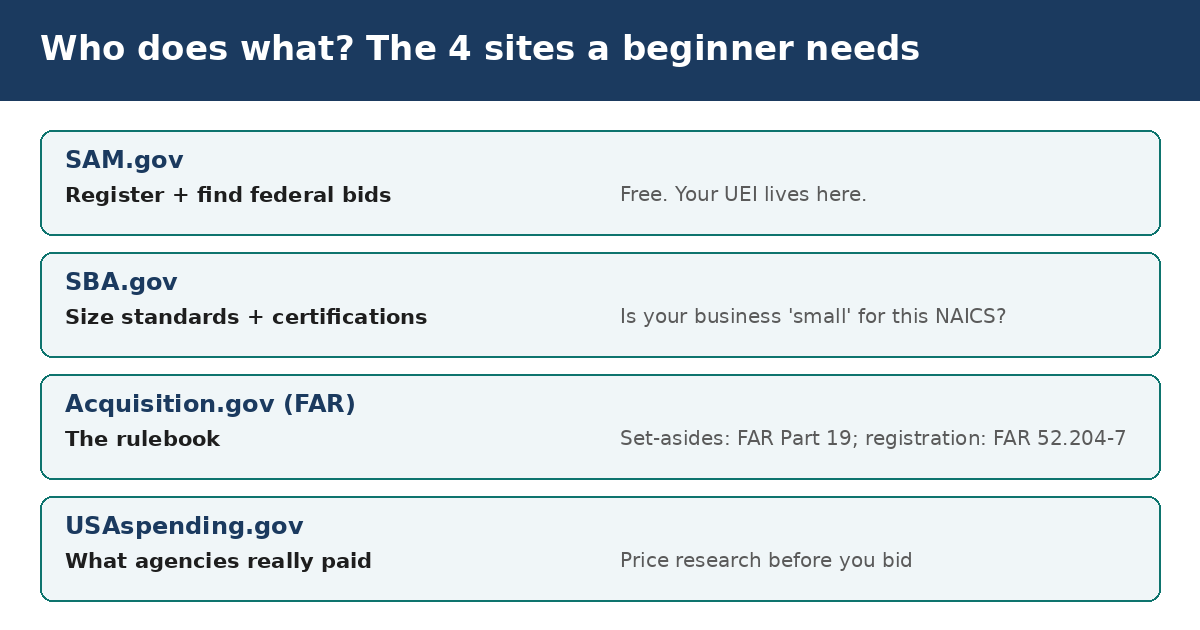
Days 4–10 — wait, and use the wait. Registration is free but not instant. The Federal Service Desk tells you to allow up to 7–10 business days while the IRS checks your tax ID and your details get validated. Under FAR 52.204-7, your registration must be active when you submit an offer and when the award is made, so this wait matters. While it runs, do useful prep: write down your real prices, your crew size, your service area, and a plain one-page note on what your business does well.
Days 11–20 — hunt small. Once you are active, look at open work every day for ten minutes. Our live government bids list groups open bids by trade and state and links each one back to its official posting. Shortlist three bids that are small, near you, and set aside for small businesses. Check what similar work paid before on USAspending.gov, the official federal spending database, and glance at the firms already winning in your field in our government contract companies directory.
Days 21–30 — bid one, properly. Pick the best fit of the three and bid it properly, using the worked example and checklist below. One complete, on-time bid teaches you more than ten half-finished ones.
How do you know if your business counts as “small”?
“Small” has a legal meaning, and it changes by industry. The U.S. Small Business Administration (SBA) sets a size standard for every NAICS code — a ceiling in annual revenue or in employees. Sit under the ceiling for the code on a notice, and you are small for that contract, full stop.
Why beginners should care: a set-aside is a contract only small businesses may bid on. Contracting officers create set-asides under FAR Part 19 when they expect at least two small businesses to offer a fair price — the “Rule of Two.” That means the giant national firms are locked out and you are competing with businesses your own size. If you already run a small cleaning, landscaping, trades, or supply business, you are probably eligible for more set-asides than you think. Our Week 1 guide, how to get government contracts as a small business, goes deeper on set-asides and on the extra certifications — 8(a), HUBZone, women-owned, and service-disabled veteran-owned — if you want that next layer.
Worked example: a real open bid a beginner can actually learn from
Enough theory. Here is a real contract from this site’s live data on November 19, 2026. It is open now, it is small-business only, and it is the kind of first bid we would point a beginner to.
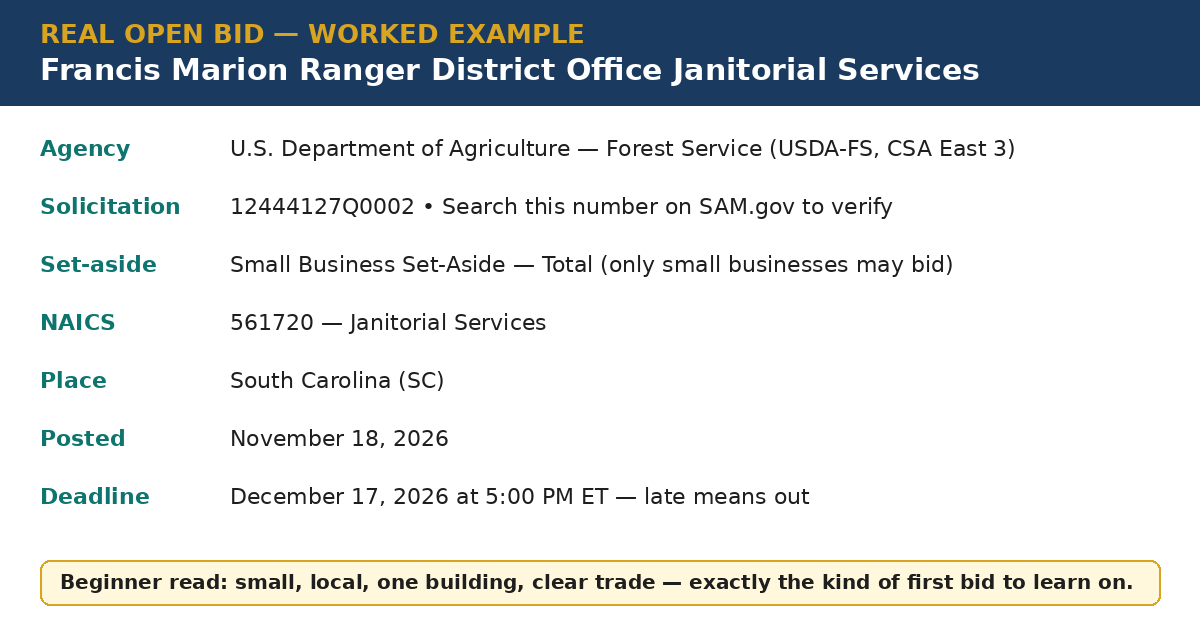
Read it the way an experienced bidder reads any notice:
- Title and agency. “Francis Marion Ranger District Office Janitorial Services” — one ranger district office, cleaned on a schedule. The buyer is the U.S. Department of Agriculture, Forest Service. Small building, clear scope, no mystery.
- Set-aside. “Small Business Set-Aside — Total.” Only small businesses may bid. If you clean buildings for a living, this pool was built for you.
- NAICS 561720. Janitorial Services. If that code is in your SAM.gov profile and you sit under its SBA size standard, you qualify on size.
- Place. South Carolina. Work you can drive to, walk through, and price honestly beats work three states away you have only seen on a screen. Beginners should start local — use the government bids by state hub to stay close to home, and the facilities, janitorial and landscaping bids page to stay inside your trade.
- Deadline. Quotes close December 17, 2026 at 5:00 PM ET. Posted November 18, that gives a beginner about four weeks — enough time to read the notice twice, ask a question the way the notice allows, price the rooms, and submit early.
- How to verify it. Search solicitation number 12444127Q0002 on SAM.gov and read the official posting yourself. Always do this. Listings get copied and go stale; the official notice is the only version that counts.
Notice what this bid does not ask for: no security clearance, no nationwide footprint, no exotic equipment. Thousands of notices like it post every month. Beginners lose not because the work is too hard, but because they aim at contracts that were never sized for them.
The mistakes that knock beginners out (and how to skip them)
| Beginner mistake | What happens | Do this instead |
|---|---|---|
| Bidding before SAM.gov registration is active | Your offer cannot be accepted, however good the price | Register first; wait for “active” status before you bid |
| Paying a company to “register you on SAM.gov” | You paid for something the government gives away free | Register yourself on SAM.gov; it is always free, renewal too |
| Aiming at huge or nationwide contracts first | You compete with firms built for that scale, and burn out | Start with one small, local, set-aside contract in your trade |
| Skimming the notice and missing a form | Incomplete bids are not considered | Read the notice twice; tick the checklist below line by line |
| Missing the deadline by minutes | Late is out. There is no grace period | Submit a day early, in the notice’s time zone, and save proof |
| Guessing a price with no research | You win work you lose money on — or price yourself out | Check past awards on USAspending.gov and walk the site if you can |
Your first bid, step by step
When your shortlist is ready, the bid itself is methodical. Our full guide on how to bid on a government contract walks the whole process; here is the beginner-short version, with the checklist experienced bidders quietly use every time.
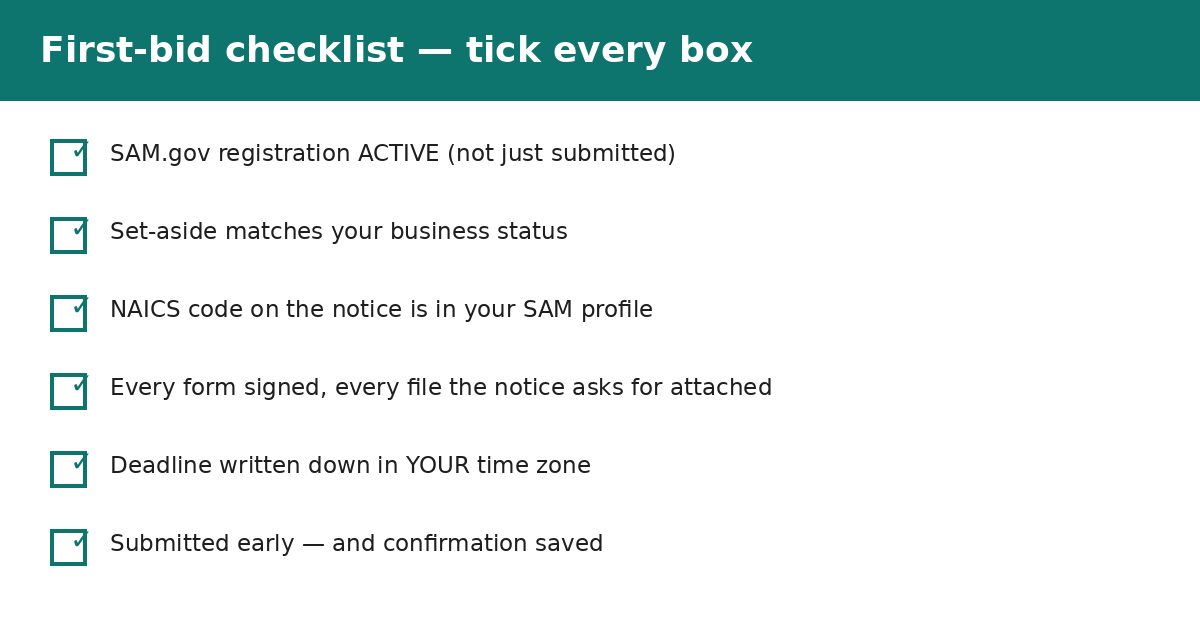
- Read the notice twice. First pass for the basics — what, where, when. Second pass with a pen: every form, every file format, the exact submission method (email, portal, or mail — the notice decides, not you).
- Price it honestly. Labour, supplies, travel, and a fair margin. Past awards on USAspending.gov tell you the going range.
- Tick the checklist. Registration active, set-aside matches, NAICS listed, forms signed, deadline converted to your time zone.
- Submit early and save proof. A day early is on time with room to spare. Keep the confirmation and a copy of everything you sent.
- Win or lose, keep the record. A loss still teaches you the buyer’s format. A win becomes past performance — the thing evaluators score on your next bid.
Frequently asked questions
How do beginners get their first government contract?
Register free on SAM.gov, wait until the registration shows active, then bid one small contract that is set aside for small businesses, in your own trade, close to home. Submit a complete bid a day before the deadline and keep proof. That simple path is how most small firms start.
Is SAM.gov registration free for beginners?
Yes. Registration and renewal on SAM.gov are always free. Companies that charge to register you are selling help you may not need — the registration itself costs nothing, and anyone who implies the government charges for it is misleading you.
What is a UEI number and does a beginner need one?
The UEI (Unique Entity ID) is your business’s ID number in federal systems. SAM.gov assigns it during registration — you do not apply for it separately, and it replaced the old DUNS number in April 2022. You need an active SAM.gov registration, with your UEI, before you can receive a federal award.
How long does it take a beginner to win a first contract?
It varies, and anyone who promises you a date is selling something. Registration alone can take up to 7–10 business days to become active. After that, a steady rhythm — checking open bids daily, shortlisting honestly, and submitting complete bids — matters more than speed. Treat your first bids as paid education: each one makes the next one faster.
Do beginners need 8(a), HUBZone, or other certifications to start?
No. A general small business set-aside only needs an active SAM.gov registration and a business that sits under the SBA size standard for the notice’s NAICS code. Certifications like 8(a), HUBZone, women-owned, and service-disabled veteran-owned open extra reserved pools later, once you know buyers in your trade use them.
Where should a beginner look for government contracts?
Federal work posts on SAM.gov, and state and local work posts on state procurement portals. A filtered daily list saves a beginner real time: this site’s live bids page groups open bids by category and state, shows the deadline up front, and links every listing back to its official source so you can verify before you bid.
Sources: SAM.gov and the Federal Service Desk (registration, UEI, CAGE, 7–10 business day activation guidance); U.S. Small Business Administration (size standards, set-aside and certification programs, FY2025 small business scorecard); Federal Acquisition Regulation Part 19 and FAR 52.204-7 via Acquisition.gov; USAspending.gov. Worked example: SAM.gov solicitation 12444127Q0002, U.S. Department of Agriculture, Forest Service, posted November 18, 2026, as listed in Daily Government Bids live data on November 19, 2026. Deadlines and availability change — always confirm a listing at its official source before bidding.